
Two-tier affiliate programs: pay partners for the partners they recruit
OpenPartner now has two-tier commissions. Turn them on for a program, and a partner who brings in other partners earns a set share of what those partners earn: a percent of their commission, paid on top of it, two levels deep. When a sub-affiliate program is worth running, how it works, and how to set one up with guardrails.
Some of your best partners don’t only send you customers. They know other people who could. An agency with a bench of freelance writers, a creator who coaches other creators, the person who runs a newsletter about your category and knows everyone who writes about it. A two-tier affiliate program, also called a sub-affiliate program, pays them for that: partner A brings in partner B, and A earns a share of what B earns.
OpenPartner now has two-tier commissions. They’re off until you turn them on, program by program. The share is a percent of the recruit’s commission, not of the sale, and it’s paid on top of that commission. It stops at two levels.
Below: what two-tier means, when it’s worth turning on, how it works, and the guardrails we’d put in place before you do.
The screenshots show the OpenPartner dashboard with demo data. Notewise, Ada Reyes and the partners she recruited are made up.
Two-tier, not performance tiers
“Multi-tier commissions” gets used for two different features. One is performance tiers: a partner’s rate goes up as they sell more. OpenPartner has those too (see Commission tracking software for how the two differ). This post is about the other one: paying partners for the partners they recruit.
Here’s how it works in OpenPartner:
- A recruiter and a recruit. Ada shares her recruit link. Marco applies through it and becomes her recruit. You can also set or change a partner’s recruiter yourself.
- A share of the recruit’s commissions. In each program that pays for recruiting, Ada earns a set percent of the commissions Marco earns there. At 10%, Marco’s $50 commission earns Ada $5. Marco still gets his full $50, so that sale costs you $55 in commissions.
- Two levels, never more. If Marco then recruits Priya, Marco earns on Priya, but Ada earns nothing on Priya. A recruiter commission never pays a share of its own.
Paying a share of the commission, not of the sale, keeps the maths simple. A recruiter can never earn more than their recruit, and the share follows whatever terms the recruit is on.
When it’s worth turning on
Two-tier works best when your partners are peers who know each other:
- Agencies and networks that bring their own sub-affiliates and want credit for building that bench.
- Creators who know other creators in your niche: a YouTuber who runs a course for smaller channels, a newsletter writer with a community of other writers.
- Programs that have run out of warm introductions. Your existing partners may know people your own outreach doesn’t reach.
It’s a worse fit for customer refer-and-earn programs, where the “partners” are your users inviting friends, and for any program where you can’t see who’s joining. And if the share is the main reason people join, you’re rewarding recruiting over selling. The US Federal Trade Commission’s guidance on multi-level marketing explains why regulators look hard at pay for recruiting rather than for sales to real customers. OpenPartner pays nothing for a partner simply joining: the recruiter’s share comes only from commissions the recruit earns on their own referrals.
How it works
Turn it on for a program
On the new-program or edit form, under Programs, tick Pay partners for the partners they recruit. Set the recruiter’s share, as a percent of the recruit’s commission (above 0, up to 50%), and optionally how many months it lasts (1 to 120), counted from when each recruitment starts: when the recruit applies through the link, or when you set their recruiter. Leave the months blank and it lasts as long as the recruit earns.
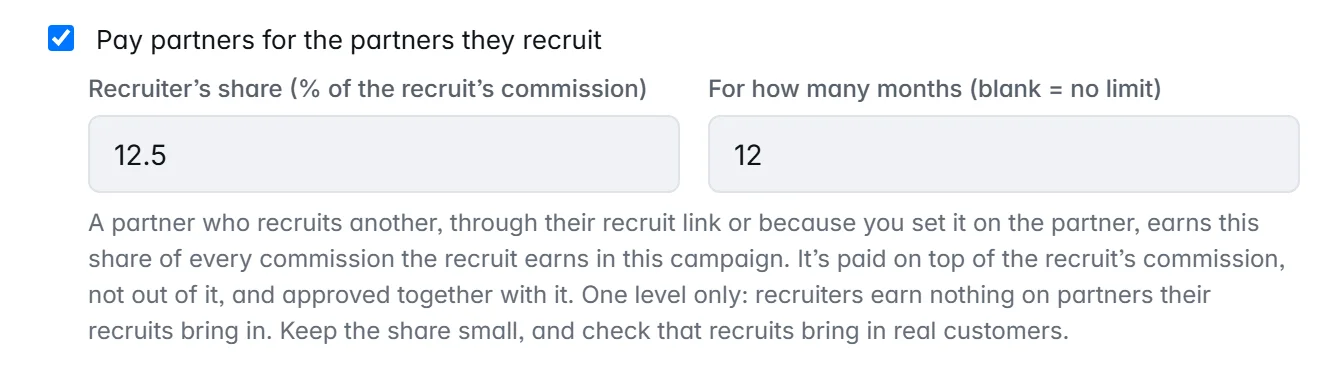
Turning it on, or changing the share later, applies to commissions from then on. Nothing already earned is recomputed.
Partners recruit with their own link
Once a program they’re in pays for recruiting, partners get a Recruit partners page in their portal. It has their recruit link, what each program pays them for recruiting, and the partners they’ve brought in, newest first, with what each one has earned them so far.
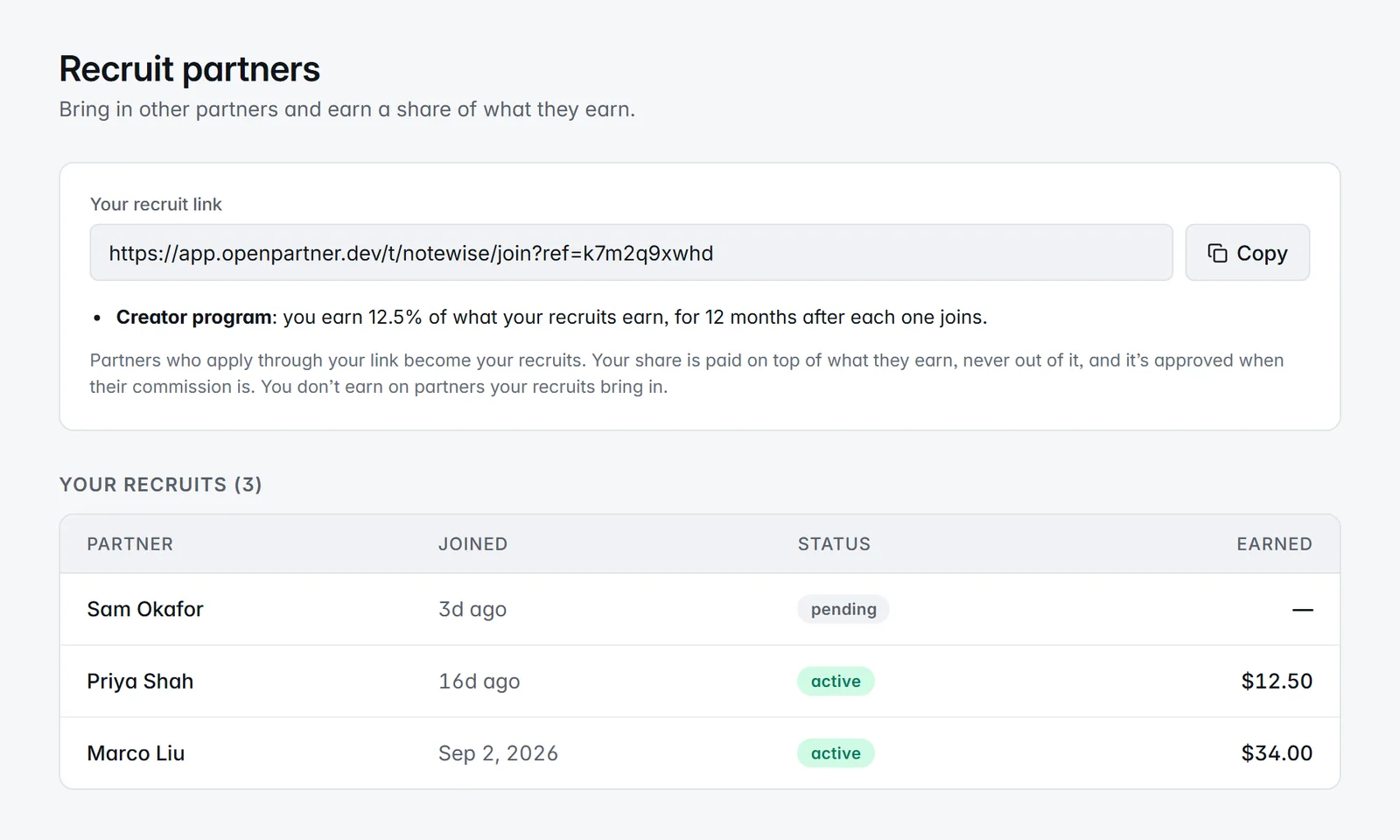
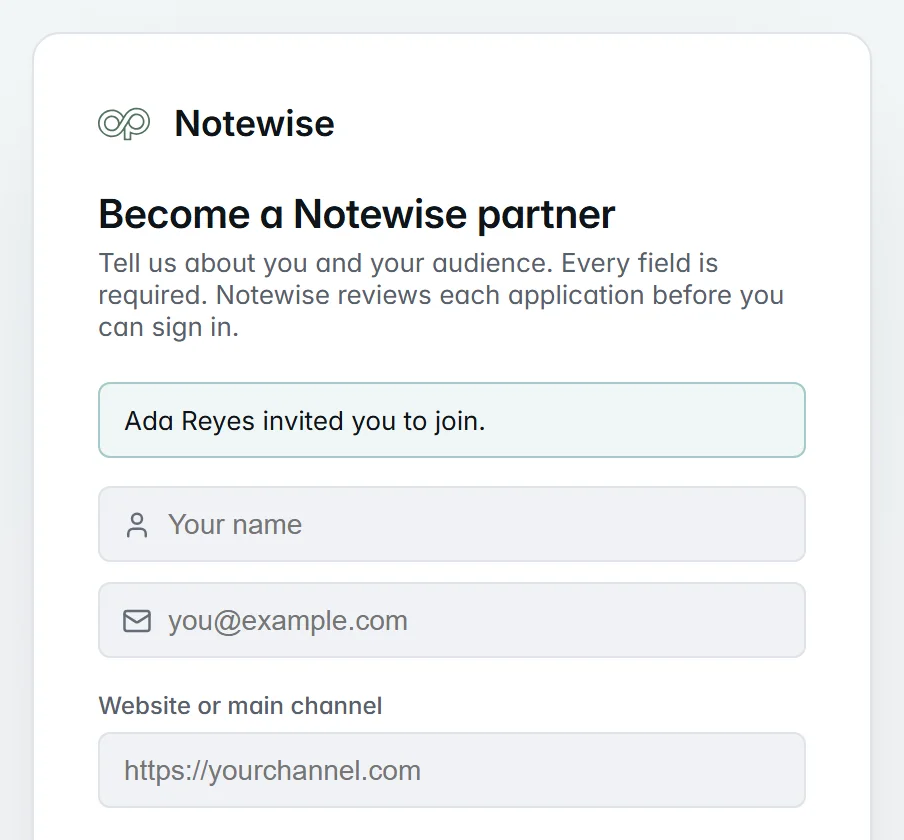
The link opens your partner join page, which tells the applicant who invited them. Applying through it makes them that partner’s recruit from the moment they apply. It doesn’t skip anything: if you review applications, you review these too.
You can also set, change or clear a partner’s recruiter yourself, from the Commission
page of any partner, or with recruitedByPartnerId in the
Partners API. Either way, a recruiter only earns on sales
from after they became the recruiter, and commissions already earned stay with whoever
earned them.
The recruiter’s commission follows the recruit’s
A recruiter commission is a commission like any other, on the recruit’s sale, and it moves with the commission it’s a share of:
- Approved together. When the recruit’s commission is approved, by you or when its holdback ends, the recruiter’s share is approved in the same step. It has no holdback of its own, so the recruit’s holdback covers both.
- Refunds cut both. A refund reduces the recruit’s commission and the recruiter’s share by the same proportion. If the share was already paid, it stays paid and the refunded part is recorded as a clawback, the same way as any commission.
- Reversals carry through. Reverse the recruit’s commission and the share is reversed too, or clawed back if it was already paid. If a payout is moving the share at that moment, reverse the recruit’s commission again once the payout settles to finish it.
In commission lists and on payout statements, it reads “Recruiter commission: Marco Liu,
invoice paid”, so nobody has to guess what it was for. Webhooks carry sourceCommissionId
and recruitedPartnerId so your own systems can tell it apart
(details).
The recruit’s sale stays theirs
Partners who run paid traffic often forward conversions to their own tracker with a postback URL. A recruiter’s postback for a recruiter commission carries nothing of the recruit’s sale: the click ID, sub-ID, event ID, transaction ID and sale amount macros aren’t filled in, because they’re the recruit’s tracking data and their customer’s transaction. What the recruiter earned, its status and the program still come through (postback docs).
Guardrails we’d put in place
Two-tier gives partners a reason to recruit, including people who’ll never sell anything. Before you turn it on:
- Start with a small share, say 5 or 10% of the recruit’s commission. You can raise it later, and a change only applies from then on.
- Review applications. Set Admin → Settings → Partner signups → When someone applies to Hold for review, so you see every recruit before they can sign in.
- Keep a holdback at least as long as your refund window. The recruiter’s share waits for the recruit’s commission, so the holdback protects both.
- Use the months limit if you want to reward the introduction rather than pay forever.
- Check that recruits sell. The Recruiting section on each partner’s Commission page lists who they recruited and what each recruit has earned them. A recruiter whose recruits never bring in customers is a signal.
One thing OpenPartner doesn’t do yet: check for self-referral, such as one person recruiting their own second account. Beyond your application review and the holdback, nothing stops it, so the review step matters.
What it costs
Two-tier commissions are on every plan, with no add-on. On the hosted plans, a recruiter’s share counts as commission on that sale for the platform fee. That only changes your fee when all the commissions on the sale, the share included, come to more than 30% of it: a 20% commission plus a 10% share is 22%, so you still pay 3% of the sale on Revshare, or 1.5% on Flex (how the fee works). Partners pay nothing.
Limits worth knowing
- Two levels only. If you need sub-affiliates three or more levels deep, OpenPartner isn’t the tool for that.
- The share is per program. You can’t give one recruiter a different share from the rest.
- Only the recruit’s commissions pay a share. Their bonuses and bounties don’t.
- Recruit links are for your own join page. Creators on the OpenPartner Network see recruiter commissions in their earnings, but the Network has no recruit link of its own.
Get started
- Turn it on: Admin → Programs → Edit on any program (docs).
- Set a recruiter: Admin → Partners → Commission on any partner (docs).
- Tell your partners: their side is in Recruit partners.
- Integrate:
recruitedByPartnerId,GET /partners/{id}/recruitsand the webhook fields are in the API docs.