
Flat fee, commission, or both? How to structure a brand deal
A flat fee pays you for the post. Commission pays you for what the post sells. A hybrid does both. When each one makes sense, worked numbers for all three, and the questions to ask a brand before you agree.
A brand likes your work and asks what you charge. There are three ways to answer:
- A flat fee. The brand pays a set amount for the post, whatever it sells.
- Commission. The brand pays you a share of the sales your link brings in.
- Both. A smaller flat fee for the post, plus a tracked link that keeps earning commission after the post goes live.
None of them is right every time. What separates them is who carries the risk that the post doesn’t sell. On a flat fee, the brand carries it. On commission, you do. A hybrid splits it. Which split makes sense depends on what you’re promoting, how sure you are that it sells to your audience, and when you need the money.
This post covers when each shape fits, with worked numbers, then the questions to ask before you agree, and how OpenPartner handles each one.
The numbers in this post are illustrative. They're picked to make the maths easy to follow, not benchmarks for what you should charge or expect to earn.
Flat fee: paid for the post
A flat fee pays for your time, your production and your audience’s attention. You’re paid the same whether the post sells nothing or sells out.
It’s the right shape when:
- The brand wants reach, not sales. A launch, a rebrand, a category nobody searches for yet. If the goal is “people should know we exist”, you shouldn’t be the one betting on conversions.
- The sale happens where a link can’t follow it. Products sold through demos and a sales team, or contracts signed offline, are hard to tie back to your link unless the brand tracks the whole path. If it doesn’t, commission on them is a long shot.
- You don’t know the product. You can’t judge whether the brand’s pricing page converts or whether its trial is any good. A flat fee doesn’t depend on its funnel.
- The work is the product. Scripting, filming and editing a dedicated video costs the same whether it sells or not. If the brand wants to run your video as an ad, those usage rights are part of what it’s buying too.
Worked example. Your rate for a dedicated YouTube review is $1,800. The brand pays $1,800. If the video brings in no customers, you have $1,800. If it brings in 60, you still have $1,800.
That second case is the cost of a flat fee: you don’t share in a post that does well. And unless the brand tracks the post, neither of you knows how well it did, so the next negotiation starts from your follower count again.
Commission: paid for what it sells
Commission pays you for each sale your link brings in: a percentage of the sale, a fixed amount per customer, or a mix. You carry the risk, and you keep the upside.
It’s the right shape when:
- The content keeps working. Tutorials, reviews, comparisons, a “tools I use” page, a link in a pinned comment or your newsletter footer. A post people keep finding through search for two years can earn commission for two years. A flat fee pays once.
- You know it sells to your audience. You use the product, your audience asks about it, or tracked links from earlier posts show it converts.
- It’s a subscription with recurring commission. You earn on renewals, not just the first payment, so a customer who stays two years pays you for two years, up to any cap.
- The brand can’t afford your flat fee yet. A small brand with a good product may not have $1,800 for a video, but can pay well per customer.
Worked example. A SaaS tool costs $40 a month. Its program pays 20% recurring for each customer’s first 12 months: $8 a month per customer, up to $96. Say the average customer pays for 10 of those 12 months. You earn $80 per customer.
| Customers from the video | You earn |
|---|---|
| 5 | $400 |
| 20 | $1,600 |
| 50 | $4,000 |
Against a $1,800 flat fee, commission alone pays more once the video brings in 23 customers ($1,800 ÷ $80 = 22.5). So the real question is whether you think the video brings in 23 or more paying customers. With tracked results from earlier posts, you can answer that with numbers. Without them, you’re guessing, and a guess is a good reason to take some of the money as a flat fee.
Timing matters too. A flat fee is paid around delivery. The $1,600 for 20 customers is earned $8 at a time, as each customer pays, and each commission is paid out after it clears the brand’s holdback and reaches its next payout run. If those customers sign up over the first three months and some stay the full 12, their last commissions are earned more than a year after you posted.
A one-time commission, say $50 per new paying customer, is earned on each customer’s first payment, so it comes in sooner: 20 customers earn you $1,000 without waiting on renewals. It’s less in total, and nothing after.
Both: a fee for the post, a link that keeps earning
The hybrid is a smaller flat fee for the post, plus a tracked link on the brand’s commission program. The fee pays for your work. The link pays you for what the post sells, during the campaign and after it.
It’s often the easiest deal to agree, because it works for both sides:
- You get a floor. If the post sells nothing, you’re still paid for your work.
- The brand risks less up front. It pays more only when the post brings in sales.
- The results are on the record. The tracked link records clicks, conversions and revenue, for the brand and for you. Your next pitch quotes results, not follower counts. If you share the same link in other posts, its numbers include those too.
Worked example. Same video, same product. You charge $900 flat instead of $1,800, plus the same 20% recurring commission.
| Customers | Flat fee only | Commission only | Hybrid |
|---|---|---|---|
| 5 | $1,800 | $400 | $1,300 |
| 20 | $1,800 | $1,600 | $2,500 |
| 50 | $1,800 | $4,000 | $4,900 |
Against the full flat fee, the hybrid gives up $900 if the video flops, and comes out ahead from 12 customers ($900 ÷ $80 = 11.25). Against commission only, it’s $900 better in every row.
The brand’s side of the same table is your pitch. At 50 customers, each paying $400 over 10 months, the brand takes in $20,000 and pays you $4,900. At 5, it pays you $1,300 instead of $1,800.
Price the flat part so you’re not out of pocket if nothing sells: your time, your production costs and the slot you’re giving up. Don’t discount it by commission you hope to earn. Commission is the upside, not a down payment.
Two things make a hybrid’s long tail shorter than it looks:
- Commission that isn’t recurring. If the program pays once per customer, the tail is new customers only.
- A program with an end date. Ask whether the program ends, and what happens to your commission when it does.
And one thing that’s often misread: the attribution window isn’t how long your post keeps earning. It’s how long after a click the brand still credits you with a customer’s first conversion, such as a signup or a first purchase. A viewer who finds your video next year and clicks your link then starts a new window from that click.
Bonuses and bounties: paid for hitting a goal
Two more levers sit on top of any of the three shapes.
A bonus is a one-off payment that isn’t tied to a sale: for an extra deliverable, a quick turnaround, or a post that did better than either of you expected.
A performance bounty is a goal with a reward, for example “Reach 10 new sales between Nov 1 and Dec 31 to earn $500”. Hit the goal and you earn the bonus on top of your commission.
Bounties are useful in a negotiation. If a brand won’t move on your flat fee, ask for a bounty instead. The brand pays only if the post performs, and you’re paid more if it does. Count it as upside, though: keep the guaranteed part of the deal enough to pay for the work.
Worked example. Take the hybrid above and add a $500 bounty for 25 new subscriptions by the end of the quarter. Say the customers in each row all sign up within the quarter.
| Customers | Hybrid | Hybrid + bounty |
|---|---|---|
| 5 | $1,300 | $1,300 |
| 20 | $2,500 | $2,500 |
| 50 | $4,900 | $5,400 |
At 20 customers you miss it. A bounty is a real target, not a gift. Before you agree one, pin down exactly what counts: sales or new customers, which dates, and whether refunded sales come off.
What to ask before you agree
We covered these questions in depth in what to look for in a brand’s program. For a single deal, these are the ones that change what you’re paid:
- The rate, in writing. The fee and its currency. The commission rate, and what it’s paid on: the first payment, every payment, or a fixed amount per customer. A rate in an email is a rate. A rate on a call is a conversation.
- Recurring or one-time, and any cap. This decides whether the long tail lasts a few months or a few years. 20% for 12 months and 20% for as long as the customer pays are very different deals.
- The attribution window. How long after clicking a viewer can sign up or buy and still count as yours, and whether a customer’s renewals stay with you after the window closes.
- Holdback and refunds. How long commission waits before it’s approved, and what happens when a customer refunds, before and after you’ve been paid.
- The payout schedule. When the flat fee is paid (on booking, on delivery or once the brand approves the post), how often commission is paid out, and any minimum payout.
- What “delivered” means. Format, date, where the link goes, how long the post stays up, and what the brand needs to see to approve it. Agree it now, so approval isn’t a second negotiation.
If you’d rather ask all of it in one message:
Thanks, happy to do this. Before I confirm, could you send me:
- The fee, its currency, and when it’s paid
- The commission rate, whether it’s recurring, and any cap
- Your attribution window, and whether renewals stay with me after it
- Your holdback, and what happens to commission on refunds
- How often you run payouts, and how you pay
- What you need to see to approve the post
A brand with a real program can answer all of it in one reply.
How OpenPartner handles each shape
You can run all of these from one creator profile, and OpenPartner takes nothing from creators on any of them. The screenshots below are from the example storefront in our storefronts launch post, with demo data.
Flat fee: storefront packages. Your storefront lists what you sell, with your prices. Any brand can send you a request from it, and you agree the details and payment directly.
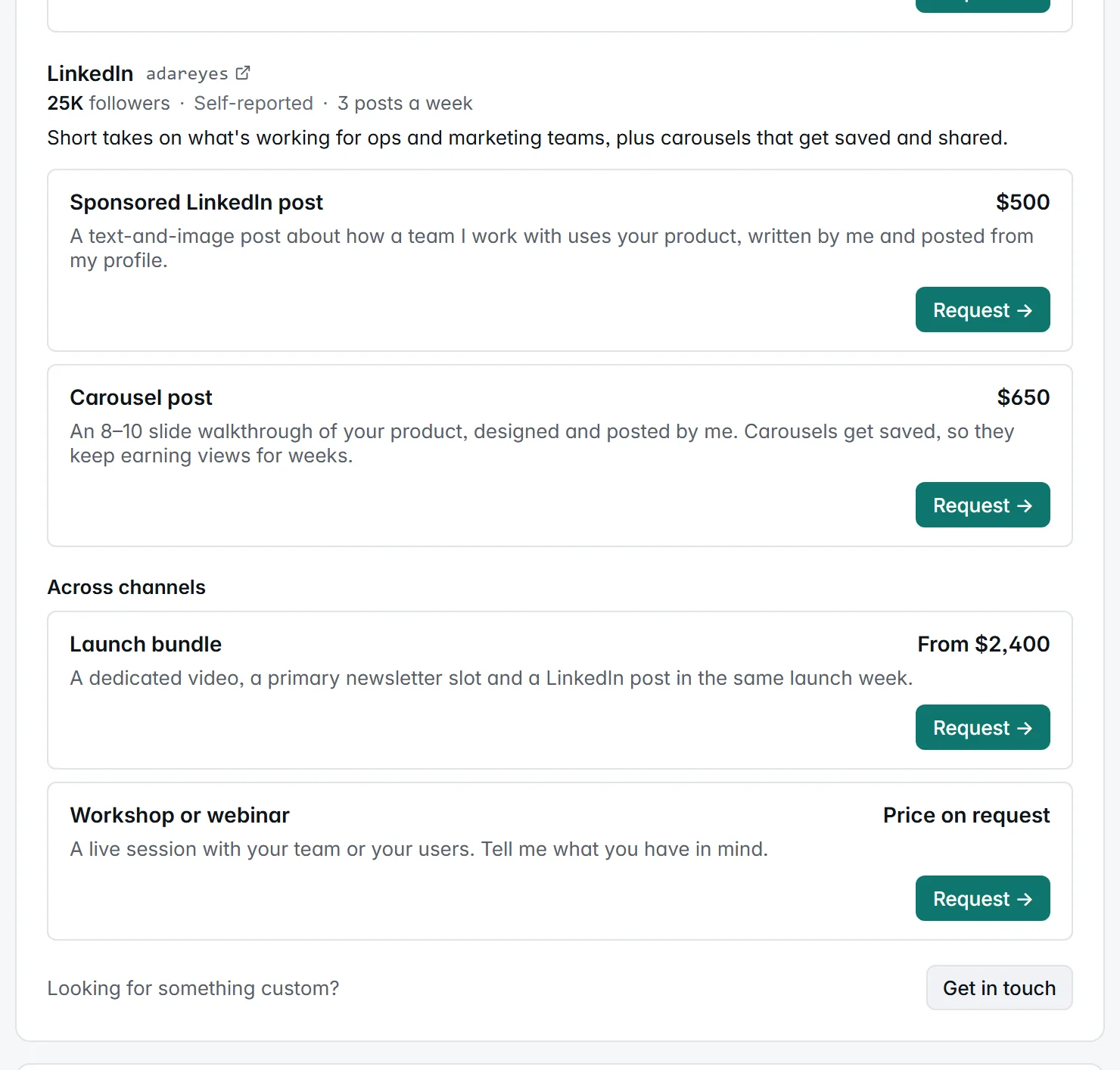
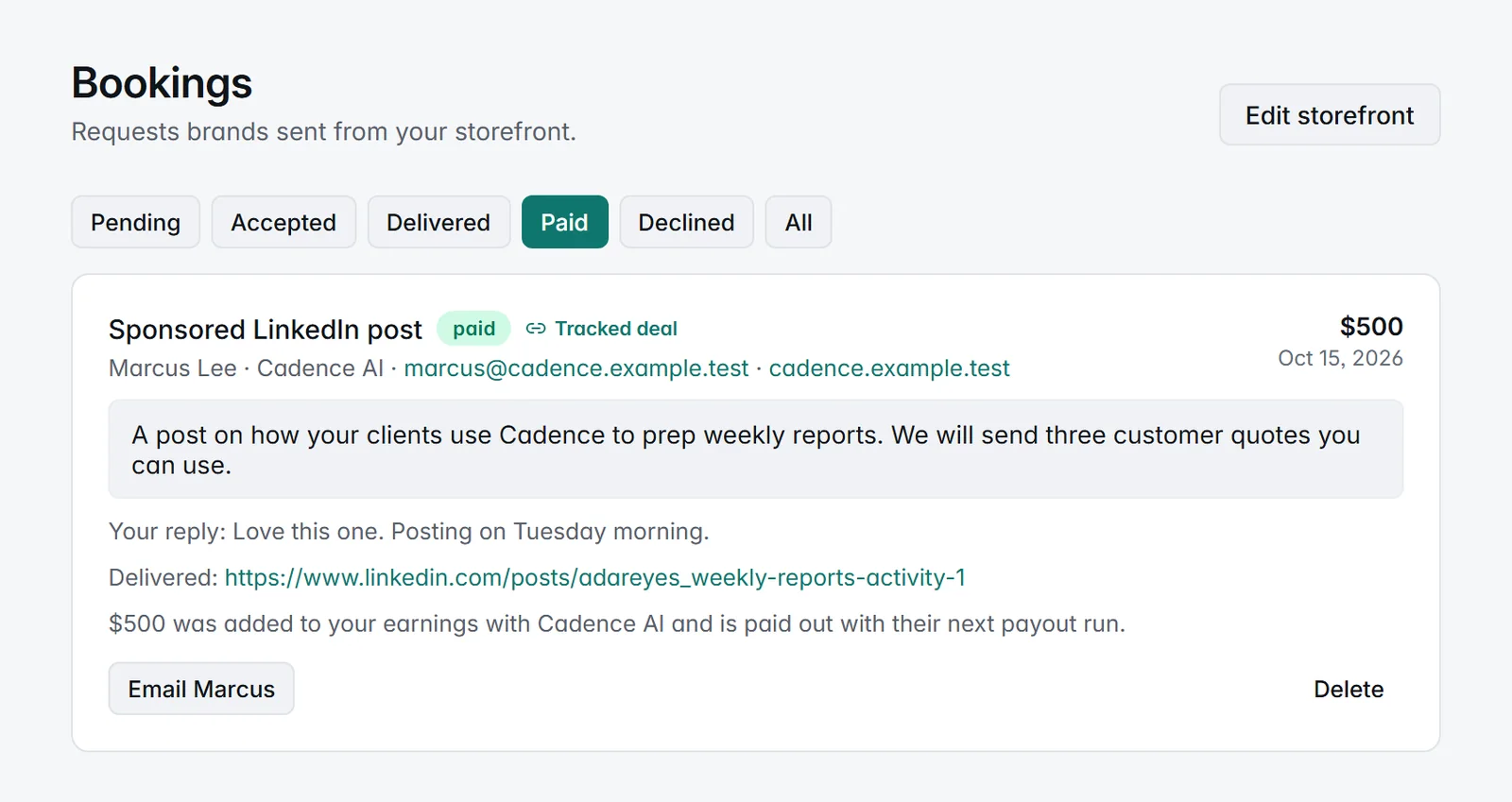
Flat fee, tracked: tracked deals. A brand that runs its program on OpenPartner can book you for an agreed amount. You accept, post with a tracked link and mark it delivered. Once the brand approves the post, the amount is added to your earnings with that brand and paid out on its payout schedule, the same way as commission.
Commission: brand programs. Apply to programs in the marketplace. Each listing shows the commission, attribution window and holdback before you apply. Once you’re approved, a later change to the program’s rate applies to new partners, not to you.
Hybrid: a tracked deal on a program that pays commission. This is the hybrid with no extra setup. The agreed amount pays for the post, and your tracked link keeps earning on the program’s usual terms after the deal is done. A sale the post drives next month still earns you commission.
Bonuses and bounties. A brand can pay you a bonus at any time, and set performance bounties on its programs. In a brand’s partner portal, the Bounties page shows the ones you can earn and your progress, updated every hour. You can earn each bounty once. Its bonus waits for the program’s holdback, and before it’s approved automatically the goal is checked again: if refunds have taken you back under it, the bonus is reversed. Bonuses sit in your earnings with the brand, labelled, next to your commissions, and are paid out the same way.
Get started
- Creators: set up your storefront and list your packages. It’s free, and guided setup walks you through it.
- Read the details: the storefront guide covers pricing, requests and tracked deals step by step.
- Evaluating a brand’s program? Start with what to look for before you promote one.